

Who Really Runs Britain? The Battle Between Democracy and the Permanent State
Considering Brexit and the ongoing 'Brexit betrayal', the expanding reach of domestic and international courts, Labour's push for more complex layers of local government, the quangos and non-governmental agencies, Britain has a growing democratic deficit. Reform UK is making the case to restore power back to where it belongs, directly to the British people through Parliament and other democratic institutions.
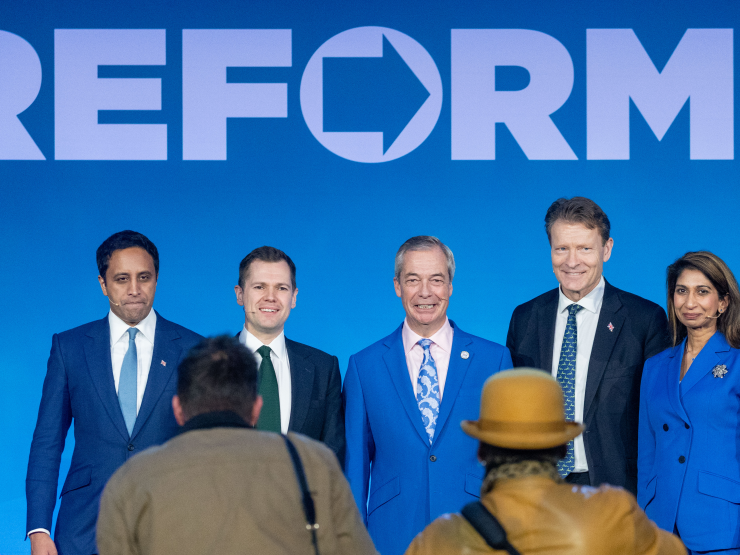
Who governs Britain?
At first glance, the answer seems obvious.
The people elect Parliament.
A government emerges from Parliament.
Ministers make decisions.
Civil servants implement them.
And voters eventually decide whether those politicians deserve to remain in office.
That's the theory.
But Danny Kruger's contribution at the Reform UK Conference 2026 raised a much more uncomfortable question:
Where does power actually reside in modern Britain?
The answer that Kruger and other Reformers have been making is that too much political authority has gradually moved away from institutions directly accountable to voters.
The Reform UK proposed solution is nothing less than a restructuring of the relationship between Parliament, ministers, the Civil Service, regulators, quangos and the courts.
Whatever your politics, the argument raises one of the most important democratic questions of our time.
Should institutions constrain politicians — or should elected politicians ultimately control the institutions?
The Problem of Power Without Accountability
Democracy contains a remarkably simple bargain.
We give politicians power.
In return, we can remove them.
That second part is crucial.
Power becomes democratically legitimate because it is temporary and conditional.
If a government raises taxes, changes immigration policy, mismanages the economy or damages public services, voters can punish it.
But what happens when important decisions are increasingly made by institutions that voters cannot remove?
This is the philosophical problem at the centre of our Reform argument.
Modern governments have to operate through an extraordinary ecosystem of regulators, agencies, quangos, courts and administrative bodies.
Many were deliberately designed to possess some element of continuity and independence from ministers. Often for good reasons.
But collectively they have grown to create something unusual, and frankly something anti-democratic:
power without direct electoral accountability.
Why Independent Institutions Exist
There is, however, an extremely strong argument for institutional independence.
Politicians aren't automatically wise simply because they have won an election.
Governments can make terrible decisions.
They can become corrupt.
They can abuse power.
They can prioritise short-term popularity over long-term stability.
Independent institutions provide friction.
Central banks can protect monetary policy from electoral opportunism.
Courts can protect individuals against unlawful government action.
Regulators can enforce standards.
Civil servants can provide continuity and expertise.
These aren't trivial advantages.
Indeed, much of modern constitutional government has been built around the idea that power should be constrained precisely because power can be abused.
But there is another side to the argument.
What Happens When the Constraints Have Become the Government?
Imagine that voters repeatedly elect politicians promising a particular change.
Yet that change repeatedly fails to happen, exactly as repeated Conservative and Labour governments have failed to deliver on economic growth, or on immigration.
Perhaps ministers encounter legal restrictions.
Perhaps regulators object.
Perhaps administrative structures make implementation extraordinarily difficult.
Perhaps international obligations limit available options.
Perhaps departments simply move too slowly.
Eventually voters may begin to ask a dangerous question:
What exactly is the point of voting?
This is where institutional restraint can begin to create its own democratic problem.
A system designed to prevent governments doing bad things can gradually make governments incapable of doing almost anything significant.
Our argument at Reform UK is essentially that Britain has moved too far in this direction, creating a system where it is near-impossible for ministers to govern. Former Conservative ministers defected to the Reform Party, have expressed precisely this view.
The Return of the Crown in Parliament
The constitutional concept underlying Reform's thinking is an old one:
the Crown in Parliament.
In simplified terms, sovereignty and democratic accountability ultimately resides in Parliament. It is a fundamental constitutional principle that as a nation we have collectively forgotten.
The executive governs through authority derived from Parliament, whose members ultimately derive their legitimacy from voters.
Reform's recently published programme, written by Danny Kruger MP and the Reform policy team argues that Reform would seek to restore this conception of sovereignty and place the Civil Service more firmly under the authority of elected government.
This represents a very different philosophy from the gradual movement towards independent institutions, judicial oversight and arm's-length administration that has characterised recent decades.
It asks a fundamental question:
Who should have the final word?
The Civil Service: Servant or Guardian?
Perhaps nowhere is this tension clearer than in the Civil Service.
The traditional ideal is admirable.
Civil servants are supposed to serve governments of any political persuasion impartially.
They provide expertise.
They warn ministers when policies may fail.
They preserve institutional memory.
And once ministers make lawful decisions, officials implement them.
But our concern at Reform is that this relationship has evolved.
The permanent administrative state, in our analysis, increasingly sees itself not merely as the servant of government but as one of the guardians of the political system. In the post-Brexit era we have an administrative body that has forgotten how to govern, either it chooses not to govern or it prefers to simply follow the line of international judges, international courts, even the EU institutions we are meant to have left behind.
Our proposed Reform solution would be to restore a much clearer hierarchy:
Voters → Parliament → Ministers → Civil Service.
Responsibility would flow upwards.
Authority would flow downwards.
It is intellectually coherent.
The Politicisation Problem
Suppose ministers receive significantly greater power to appoint and dismiss senior officials.
Government may become more responsive.
But what happens when another government takes power?
Does it replace those officials again?
And again four years later?
Britain could gradually move towards a more American model in which thousands of government positions become politically contested.
That could increase democratic control.
It could also destroy institutional continuity.
There is therefore no perfect answer.
A permanent bureaucracy can become too powerful.
A politicised bureaucracy can become too partisan, for any given period in time.
The challenge is certainly in finding the equilibrium. But who could argue that change isn't massively overdue? Change is essential if any UK elected government is ever to deliver on its mandate again.
Quangos and the Accountability Gap
Quangos illustrate the problem particularly well.
When governments create independent agencies, ministers can sometimes achieve an attractive political arrangement.
They retain some influence while avoiding complete responsibility.
If something succeeds, government can claim credit.
If something fails, responsibility can be redirected towards the independent organisation.
Our Reform solution is much simpler:
return substantially more authority back to ministers.
If ministers have the power, ministers carry the responsibility. The Reform plan is bring Britain's 400-plus quangos under the minsterial portfolio of the relevant minsters within the first 100 days of the Reform government.
And if voters dislike the outcome, they can remove them.
There is a compelling democratic logic to this.
Power should follow accountability.
But once again there is a counterargument.
Some decisions genuinely benefit from insulation from politics.
The difficult question isn't whether all quangos are good or bad.
It is: which decisions genuinely require independence — and which have merely been outsourced from democratic accountability?
That is a debate Britain nneds to have institution by institution. And it is going to happen.
The Bank of England Question
Kruger went further at the 2026 Reform Conference by raising questions about the independence of the Bank of England's monetary-policy function, describing its position as something that should be reviewed.
That takes the debate into sensitive territory.
Central-bank independence is based on the idea that interest-rate decisions should be protected from politicians tempted to stimulate the economy immediately before elections. It has been only partially successful: yes in terms of maintaining low inflation, but not in terms of delivering an economic platform for growth and wealth creation.
The counterargument is getting stronger, and it is around democracy.
Interest rates affect mortgages, employment, investment, house prices and economic growth.
These are enormously consequential political outcomes.
So why should such important decisions be insulated from democratic government?
Again, there is no black and white answer.
But the tension illustrates the broader theme perfectly.
Expert independence versus democratic control. It is only Reform who are prepared to have this debate in public and to make the Bank of England work better for ordinary British workers, and not just for financial institutions.
The Next Government Will Need to Move Quickly, but Carefully
If Reform UK enters government committed to major reform of quangos and restoring democracy by way of constitutional reform, the early decisions could be relatively straightforward.
Create the inventory of the current institutions.
Then identify the functions.
Determine which should disappear.
Determine which should return to departments.
Identify which require genuine independence.
And then examine which services could be delivered differently. A lot of this work is already being done and progressing on to creating draft legislation. Specific plans for the Cabinet Office and the immigration functions of the Home Office have already been confirmed by Reform and announced.
Implementation is no doubt going to be harder, at least that is the popular view being proposed in mainstream media.
This is going to require legislation, but also a cultural repositioning, significant training resources, departmental restructuring, workforce reform and detailed transition plans.
The greatest danger is going to be abolishing institutions faster than government could replace the functions that genuinely matter.
The greatest opportunity will be using structural reform to remove duplication and reconnect authority with responsibility.
Who Should the Public Hold Responsible?
Ultimately, the quango debate returns to the same question running through Reform's wider arguments about constitutional reform, the Civil Service and democratic institutions.
Who really governs Britain?
An advanced modern state will always require specialist agencies, regulators and expert institutions.
The issue is where their authority comes from, what limits apply to it and who answers when something goes wrong.
Our answer at Reform is that Britain needs fewer layers of government whose responsibilities are difficult for the electorate to trace.
Some organisations could disappear.
Some functions could move back into departments.
Some services could be delivered outside government.
And some independent bodies would remain where independence can be clearly justified.
The objective would not simply be a smaller organisational chart.
It would be a clearer relationship between power, responsibility and democratic accountability.
Because when a public institution exercises significant power, voters should be able to answer one fundamental question:
Who is ultimately responsible for what it does?



Real Change for Britain and Protecting Free Speech Will Take Courage to Vote For Something Different