

Britain Must Get Back to Economic Growth and Better Tools for Fighting Poverty
Britain must grow again. The next government is going to have to make reforms to make it happen.
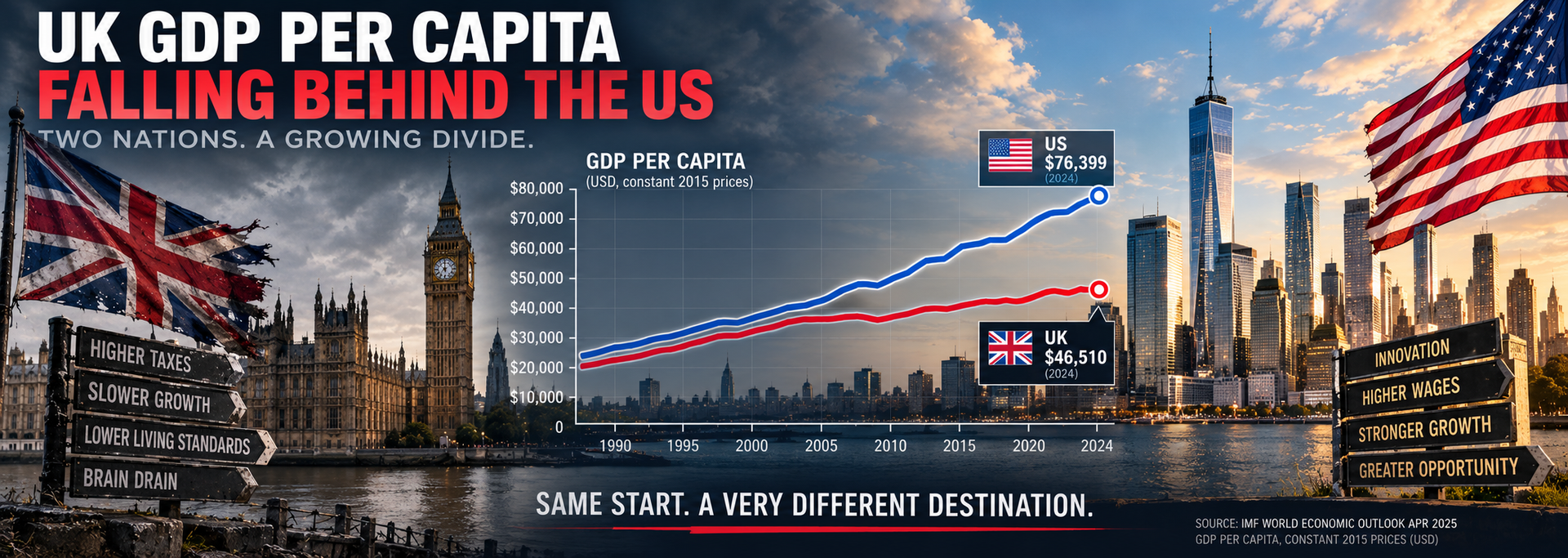
Britain’s economic challenge is no longer simply about managing the public finances.
It is about getting the country growing again.
After years of weak productivity, pressure on living standards and disappointing growth in GDP per person, Shanker Singham, Chairman of the Growth Commission, is in agreement with Reform when he argues for Britain to adopt something considerably more ambitious than another round of short-term tax adjustments or government spending initiatives.
It needs a fundamental change in the economic environment in which businesses invest, compete and grow.
Speaking about Britain's economic prospects in a fringe meeting at the Reform Conference 2026 Singham set out a framework based around three major drivers of prosperity: domestic competition and regulation, international trade, and an economic environment capable of encouraging investment, innovation and technological development.
His argument is ultimately optimistic.
Britain's economic problems, he says, can be fixed.
But doing so will require the next government to make some difficult choices.
The Real Measure of Growth: GDP Per Person
There is an important distinction between GDP - the measure that Labour and Conservatives say can be improved by pushing higher immigration - and the measure of GDP per person.
Headline GDP tells us whether the economy as a whole is becoming larger.
But that does not necessarily tell us whether individual citizens are becoming more prosperous.
If GDP increases partly because the population is increasing, the economy can technically be growing without producing a comparable improvement in average living standards.
That is why we at Reform, in agreement with the policy papers from the Growth Commission- place much greater emphasis on real GDP per capita.
This distinction matters.
The fundamental objective of economic policy should not simply be to produce a larger economy.
It should be to increase the productive capacity of the country so that people become more prosperous.
Britain therefore needs to ask a more demanding question than: is GDP growing?
It needs to ask: is the economy producing substantially more wealth for each person?
That is the growth challenge facing the next government.
Britain’s Long Economic Stagnation
The immediate economic picture is not one of continuous recession.
Britain is growing.
But the longer-term concern is the weakness of the underlying growth rate.
At Reform we say, that distinction is crucial.
A country can continue producing modest positive GDP figures while gradually falling behind economies that are becoming more productive, innovative and investment-friendly.
The consequences accumulate over time.
Weak productivity means weaker wage growth.
Weak investment limits the creation of productive businesses.
Weak economic growth makes public spending commitments increasingly difficult to finance.
And when government spending continues rising faster than the productive economy supporting it, pressure increases on taxation and borrowing.
Growth therefore sits underneath many of the political arguments Britain is currently having about tax, debt and public services.
Without a more productive economy, governments are continually forced to divide an economic pie that is not expanding quickly enough.
The Three Pillars of Economic Growth
The framework for growth being put forward by Reform identifies three broad areas that determine whether an economy is capable of sustained growth.
The first is the domestic competitive environment.
How easy is it for businesses to enter markets, challenge established companies, invest and expand?
The second is international competition and trade.
How open is Britain to the global economy, and how effectively can British businesses participate in growing international markets?
The third concerns the environment surrounding investment, innovation, technology and property rights.
Together, these determine whether entrepreneurs and investors have sufficient incentives to take risks.
This is important because dynamic economies depend upon experimentation.
Some businesses fail.
Others succeed.
New companies challenge established ones.
Investment moves towards more productive activities.
Technology replaces inefficient processes.Capital and labour are reallocated.
The Growth Commission also argues that governments should create an institutional environment in which this process can occur rather than attempting to protect the existing structure of the economy.
Regulation Should Encourage Competition, Not Protect Incumbents
One of the strongest arguments for growth concerns regulation.
The question is not simply whether Britain has too much or too little regulation.
The more important question is: what does the regulation actually do to competition?
Good regulation can establish clear rules, protect property rights and enable markets to function.
Bad regulation can raise barriers to entry, increase costs and unintentionally protect established businesses from new competitors.
The Growth Commission argues that Britain has allowed too many regulatory barriers to accumulate, over the years of both Conservative and Labour governments.
The result can be an economy in which large incumbent companies are better equipped to absorb compliance costs while smaller businesses and potential competitors struggle to enter markets.
That is precisely the opposite of what a growth strategy should achieve.
A dynamic economy needs new businesses constantly challenging established ones.
The next government should therefore examine regulation through a simple economic test: does this rule improve competition and economic efficiency, or does it make it harder for productive businesses to emerge?
Britain Needs to Rediscover Economic Risk
There is another philosophical argument behind this de-regulation approach. economic growth requires risk.
Entrepreneurs have to invest without knowing whether their businesses will succeed.
Investors provide capital without knowing precisely what return they will receive.
Companies develop products without knowing whether consumers will buy them.
New technologies disrupt established industries.
That uncertainty is not an unfortunate side effect of capitalism.
It is part of the mechanism through which economic progress occurs.
The Growth Commission therefore warns against regulatory systems that attempt to eliminate too much economic risk.
An economy organised primarily around preventing failure can also prevent experimentation.
And without experimentation, productivity growth eventually slows.
The objective should not be recklessness.
It should be a regulatory environment in which productive risk-taking is possible and failure does not become prohibitively expensive.
The UK-US Productivity and Prosperity Gap
In his talk at the Reform Conference, Shanker Singham repeatedly contrasts Britain's economic performance with that of the United States.
His broader point is more important than any individual statistic.
The United States has proved considerably more successful at creating and scaling many of the companies that dominate the modern technological economy.
Look at some of the world's most valuable technology businesses and a striking pattern emerges.
Many are American.
Some barely existed a generation ago. This demonstrates the importance of economic dynamism.
The most productive economy is not necessarily the one that best protects today's largest companies.
It is often the economy that makes it easiest for tomorrow's companies to displace them.
For Britain, that means asking whether its tax, regulatory and investment environment encourages the next generation of businesses to emerge — or inadvertently protects yesterday's economic structure.
Why Technology Matters So Much
Technology makes this debate increasingly urgent. Artificial intelligence, robotics, biotechnology, advanced manufacturing and digital services could dramatically increase productivity during the coming decades.
Countries that successfully attract investment in these sectors could experience significant increases in productive capacity.
Countries that regulate them poorly risk watching investment and entrepreneurs move elsewhere.
That does not mean abandoning safeguards.
It means recognising that regulation itself has economic consequences.
The recent UK economic data makes the timing of this argument particularly relevant. ONS estimates show real GDP rose by only 0.4% in Q2 2026, while real GDP per head also rose 0.4% in the quarter and was 1.0% above a year earlier. Productivity remains the deeper issue: the ONS's preferred RTI-based measure estimated output per hour was only 0.7% higher year-on-year in Q2.
There is also an important distinction worth preserving. For example, the ONS published modelling estimates that a 10% improvement in UK regulatory competitiveness could eventually raise GDP per capita by about 6.6%.
The question should therefore be how Britain can protect consumers and legitimate public interests without preventing innovation from occurring in the first place.
That balance could become one of the defining economic questions of the next decade.
The European Regulatory Question
One of the most politically contentious parts of this growth argument concerns Britain's relationship with European Union regulation.
The concern is not primarily about Europe as a trading partner. The EU will remain an enormously important market for British businesses.
But there is a major concern about regulatory alignment, in the direction taken by the present Labour government, and indeed supported by the Conservatives.
Reform are making the case that Britain's ability to design its own regulatory system represents an economic opportunity only if governments are prepared to use it.
From our perspective, automatically following EU rules would constrain Britain's ability to create a more competition-oriented regulatory model.
Supporters of closer alignment point to the potential advantages of reducing trade friction with Britain's largest neighbouring market.
Businesses trading extensively with Europe can benefit from common standards because complying with multiple regulatory systems can itself create costs.
But the important counterargument is that this trade-off must be measured against the economic cost of adopting regulations that are going to be less conducive to competition and innovation on the global scale. You only have to look at the relative economic decline of the EU nations over the last decade to see evidence of this over-regulation model.
The question is therefore not simply: should Britain align with Europe?
It is: what are the economic costs and benefits of alignment in each particular area?
Brexit Was a Decision: Why has Britain Not Done Enough With its Economic Freedom?
This leads to one of the most important distinctions in the pro-growth argument.
Brexit itself does not generate economic growth. Leaving the European Union changed Britain's legal and regulatory options.
What matters economically is what governments subsequently do with those options.
Regulatory independence that is never used produces little economic benefit.
Independent trade policy that does not open new markets achieves little.
The ability to reform domestic competition policy matters only if governments actually reform it.
In that sense, Brexit was not an economic growth programme.
It created a different set of policy choices.
Reform's criticism is that successive governments have not exploited those choices sufficiently.
The Case Against Automatic Dynamic Alignment With the EU
That is why the Growth Commission and other pro-growth economists are particularly concerned about dynamic alignment with EU regulations.
Under arrangements of this kind, Britain could agree to remain aligned with European rules in specified sectors as those rules change. Supporters argue that this can reduce barriers to UK-EU trade.
But there is also a significant potential cost.
If Britain automatically adopts rules developed elsewhere, it potentially restricts its ability to construct a distinct regulatory environment designed around domestic competition and economic growth.
The concern is therefore strategic.
Once regulatory autonomy has been surrendered in a particular area, future British governments are going to find it much harder to pursue a different economic model.
At Reform, we say this would close off precisely the supply-side reforms Britain needs. Our country would go back to the tied to a low-growth, sclerotic economic zone in the European Union.
Britain Must Remain Open to the World
The second major pillar is international trade.
Britain is not large enough to generate maximum prosperity by concentrating predominantly on its domestic market.
British companies need access to global consumers, investment and supply chains.
That means continuing to reduce unnecessary barriers to international commerce.
At Reform we say that Britain should deepen relationships with the world's faster-growing markets while retaining the freedom to pursue an independent trade policy.
That includes making greater use of Britain's participation in the Comprehensive and Progressive Agreement for Trans-Pacific Partnership and pursuing commercial opportunities with countries outside Europe.
The strategic objective should not be choosing between Europe and the rest of the world.
It should be maintaining strong European trade while simultaneously expanding Britain's ability to participate in global growth.
Competition Policy Must Protect Competition, Not Competitors
There is another subtle distinction running through this pro-growth economic philosophy.
Government should protect competition, not individual competitors.
Those are not the same thing.
Protecting a particular company can reduce competition.
Protecting the competitive process allows successful companies to emerge while unsuccessful ones decline.
This matters particularly when governments become closely involved with major businesses through procurement, subsidies or regulation.
If established companies derive substantial revenues from government contracts or operate in markets shaped heavily by regulation, the relationship between the state and large incumbents can become increasingly close.
The danger is that new entrants find it harder to compete.
A serious growth strategy should therefore highlight whether public policy is creating open markets or unintentionally reinforcing existing market structures. As the public sector has grown and grown, government procurement has grown, and the British economy is now seen as largely a state-run economy, when seen from the outside world.
The dire ecomomic growth statistics for the last 20 years speak for themselves. Britain is becoming slowly poorer relative to the rest of the world. A change of direction is now critical if we are to seriously deal with rising poverty, if we're to create new jobs, investment and better life chances.
Growth Is Also the Answer to Britain’s Fiscal Problem
Britain's growth problem cannot be separated from its debt and public-spending problem.
Governments can increase taxes.
They can reduce spending.
They can borrow.
But over the long term, the least painful way of improving the sustainability of the public finances is to increase the productive capacity of the economy as a whole.
A faster-growing economy generates a larger tax base. This is the reverse of the current economic direction under the Labour government.
A growing economy also makes existing debt smaller relative to national income.
It provides more resources for public services.
And it creates more space for future governments to reduce taxation without destabilising the public finances.
This is why growth should not be regarded as simply another government department's objective.
It is central to almost every other political priority.
How Much Difference Could Reform Make?
The Growth Commission's modelling attempts to quantify the potential gains from structural reform.
Its estimates show that relatively modest improvements in the competitiveness of regulation, international competition and the institutional environment could produce substantial long-run increases in GDP per capita.
Economic models depend upon assumptions, and other economists may disagree about the magnitude of the effects.
But the broader proposition deserves attention.
Small improvements in annual productivity growth compound.
An economy growing slightly faster every year eventually becomes dramatically larger than one that remains stagnant.
That is why structural reform can matter more than short-term fiscal interventions.
The objective is not to manufacture a temporary burst of activity.
It is to increase Britain's long-term trend rate of growth in a stable manner, based on many incremental improvements over years. That is the Reform model of governance.
What the Next Government Would Need to Do
The case bging made by the Growth Commission points towards a fairly clear economic programme.
The next government would need to reduce regulatory barriers to competition and business formation.
It would need to scrutinise regulations according to their impact on economic efficiency rather than assuming regulation is economically neutral.
It would need to encourage investment and productive risk-taking.
It would need to make Britain an attractive environment for technology companies and new industries.
It would need to pursue international trade opportunities while retaining sufficient regulatory autonomy to implement domestic reforms.
And it would need to recognise that excessive taxation, spending and debt ultimately become harder to sustain when the underlying economy is growing too slowly.
None of these reforms is individually a magic solution.
Together, however, they represent a fundamentally different approach to the economic policy of the last 20 years.
Stop Managing Stagnation
Perhaps the most important message from the pro-growth argument is that Britain should stop treating weak growth as inevitable.
Economic stagnation can become self-reinforcing.
Low growth creates pressure for higher taxation.
Higher taxation can weaken incentives to invest.
Weak investment suppresses productivity.
Poor productivity restrains wages.
Governments then attempt to compensate through higher spending, subsidies or borrowing.
Eventually the political debate becomes almost entirely about how to distribute limited resources rather than how to create more of them.
At Reform we are seeking to reverse that logic.
The central question should become: what would make Britain a better place to invest, innovate, build businesses and create wealth?
The Next Government's Economic Test
Britain does not lack entrepreneurs.
It does not lack world-class universities, financial expertise, scientific research or technological capability.
What it has lacked is sufficiently strong productivity and sustained growth in prosperity per person.
The next government will therefore face a choice.
It can continue managing an economy growing at historically disappointing rates while arguing over how the proceeds are distributed.
Or it can attempt the more difficult task of changing the underlying conditions that determine how much wealth Britain creates.
For us at Reform and the Growth Commission, that means putting competition, regulatory reform, international trade, investment and innovation at the centre of economic policy.
There are legitimate arguments about precisely how those reforms should be designed and about the trade-offs involved.
But the fundamental challenge is increasingly difficult to avoid.
Britain needs higher productivity.
It needs more investment.
It needs businesses capable of scaling.
And above all,
Britain needs to grow again.