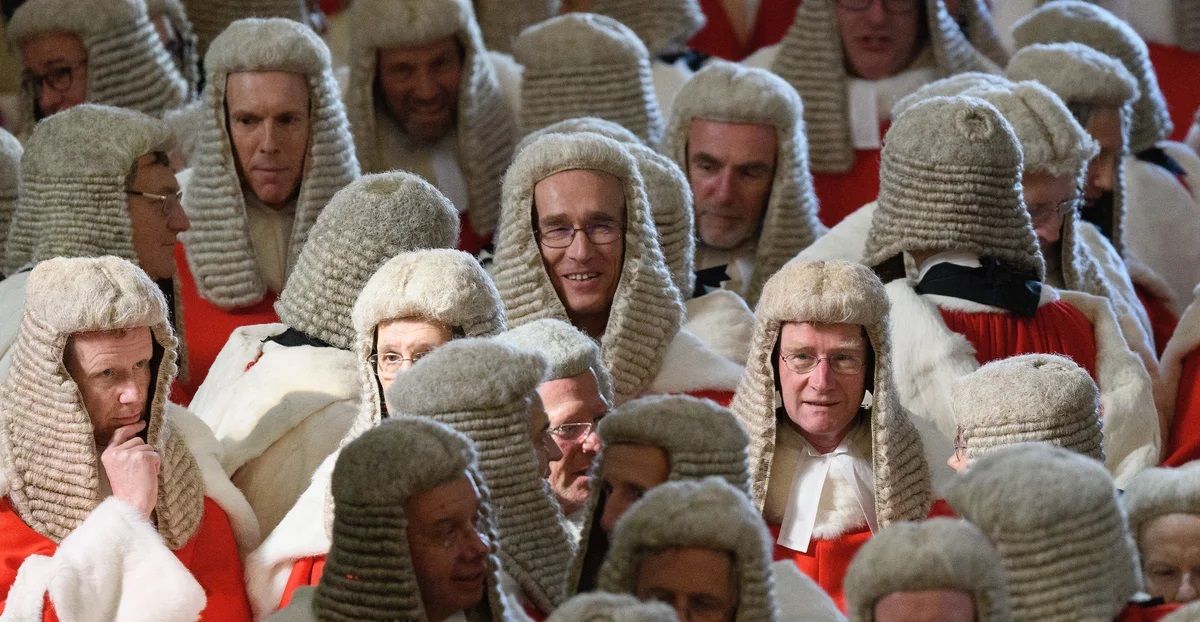

Who Should Make the Law? Reforming DEI and Britain's Politicised Judiciary
Reform has important plans to restore power to Parliament and to Britain's long-standing constitutional model.
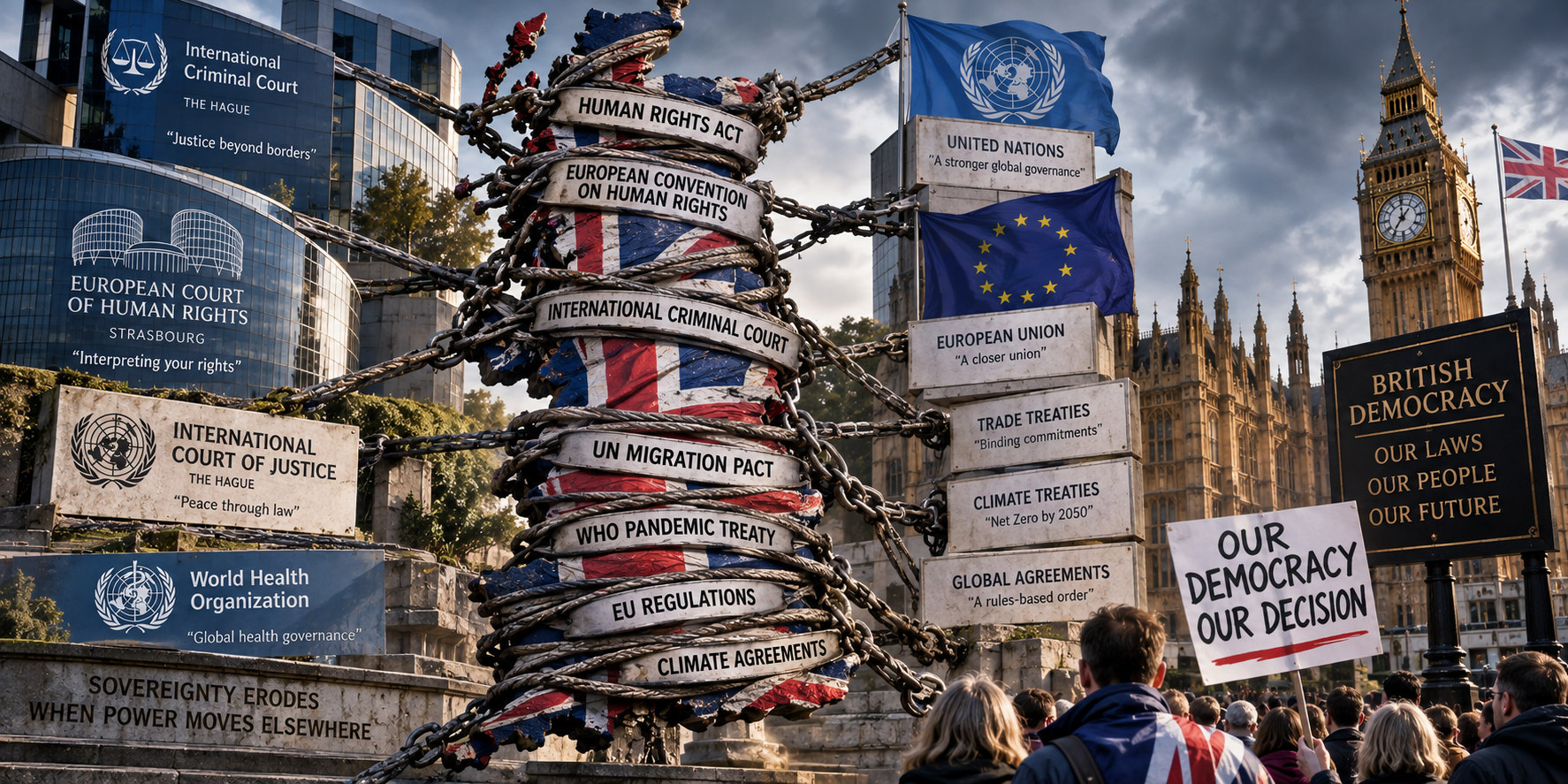
Who should ultimately decide the rules under which Britain is governed?
Parliament?
Domestic judges?
International courts?
Or an increasingly complex interaction between all three?
For us at Reform, this question lies at the centre of our plans for constitutional and judicial reform.
Speaking about the judiciary, legal training and the growing influence of international law at the Reform Conference 2026, Danny Kruger MP argued that Britain has gradually blurred the traditional distinction between judges interpreting law and politicians making policy.
We need to look at this deeply as it goes to the heart of the coming national recovery, even though it receives very little attention in mainstream media. Part of the problem has been weak legislation which has left a massive grey area for judges to interpret the law in any way they wish. Another part of the problem is that Britain has still not left behind its attachment to European laws and EU Directives.
The concern is not that Britain should abandon an independent judiciary.
On the contrary, judicial independence is fundamental to the rule of law.
The Reform argument is that judges should operate within clearer constitutional boundaries, Parliament should take greater responsibility for politically contentious decisions, and international legal frameworks should not be allowed to override what we at Reform regard as the democratic authority of elected governments.
This is ultimately a debate about where legal authority ends and democratic authority begins. Over the last 20 years governments have failed to deal with these important constituional questions.
The Traditional Constitutional Division
The British constitutional model rests on a relatively simple principle.
Parliament makes the law.
The courts interpret and apply it.
Government acts within it.
That division has never been entirely straightforward.
Judges inevitably make difficult interpretative decisions.
Parliament sometimes deliberately passes broadly-worded legislation and leaves the courts to determine how it applies in individual cases.
And governments themselves can be challenged when they act outside the powers Parliament has given them.
Nevertheless, the basic principle remains important, and it is in need of a renaissance.
Parliament is the supreme legislative authority in the UK constitution.
The courts cannot normally invalidate an Act of Parliament simply because judges disagree with the policy it contains.
At Reform we say this constitutional distinction has become less clear over recent decades.
When Does Legal Interpretation Become Policymaking?
The difficult question is where interpretation by judges should stop.
Courts frequently confront legislation whose wording does not provide a simple answer to a new problem.
Judges must consider statutory language, previous judgments, established legal principles and, where relevant, international obligations.
That is an unavoidable part of adjudication.
Our concern at Reform is that judicial interpretation has been moving beyond resolving individual disputes and it has begun shaping policy in areas that should, in our view, be determined more directly by elected politicians. Judges have been granted freedom to make what the public sees as politicised judgements, on the grounds of interpretation and in deference to internatioal laws and treaties.
Immigration provides one of the most politically contentious examples.
Questions involving deportation, asylum and family life can engage domestic legislation as well as rights protected under the European Convention on Human Rights.
Courts must then interpret how those obligations apply to individual cases.
Supporters of the present system argue that this is precisely what independent courts are supposed to do: ensure that governments exercise power lawfully and that individuals can enforce their rights.
But at Reform UK we take a different view of where the balance should lie.
Parliament should regain greater control over politically-significant decisions, particularly in immigration and border policy. It is becoming clearer and clearer, this is the only way Britain can take back control of immigration and overcome the mountain of case law that is preventing deportations and border control.
The Rise of International Law in Domestic Politics
The second part of the Reform argument concerns international law.
Britain increasingly operates within a network of international treaties, conventions and courts.
Some concern trade.
Others concern security.
Some establish human-rights commitments.
These agreements can create legal obligations that influence domestic policy.
The European Convention on Human Rights is perhaps the most politically prominent example.
The UK remains a party to the ECHR, and Convention rights are incorporated into domestic law principally through the Human Rights Act 1998.
At Reform we are proposing to change that fundamentally. Our current policy is to withdraw the UK from the ECHR and repeal the Human Rights Act.
For Reform, this is not merely an immigration policy.
It is a constitutional policy.
We argue that decisions affecting Britain’s borders and other major areas of public policy should ultimately be determined by Parliament rather than constrained by an international court. Every other legal avenue for getting back to border control has been tried and failed by previous governments.
What the European Court of Human Rights Actually Does
It is important to distinguish several institutions that are frequently confused in political debate.
The European Court of Human Rights is not an EU institution.
It interprets the European Convention on Human Rights, a separate treaty system administered through the Council of Europe.
Britain remained within that system after Brexit.
Domestic British courts also apply Convention rights through the Human Rights Act.
This means debates about the ECHR involve two related but distinct questions:
What role should international human-rights obligations play in British law?
And: how should British judges interpret those obligations domestically?
Our argument at Reform is that the present framework gives too much influence to broadly framed rights interpreted through evolving international case law. Successive governments for 20 years have been elected with a mandate to reduce immigration, but they have all failed in this policy area, because of Britain's inability to govern itself freely.
Supporters of the ECHR framework respond that human rights are deliberately protected from ordinary political majorities because their purpose is to constrain the state when fundamental liberties are at risk.
That is the constitutional disagreement at the heart of the debate. But Reform is not planning to abandon Britain's commitment to fundamental human rights, but rather to enshrine them in a new British Bill of RIghts.
Judicial Independence Is Not the Same as Judicial Supremacy
Our Reform position also requires an important distinction.
An independent judiciary is not the same thing as a judiciary with unlimited constitutional authority.
Judicial independence means judges should be able to decide individual cases without political intimidation or interference.
A Home Secretary should not be able to telephone a judge and dictate the outcome of a criminal prosecution.
A Prime Minister should not decide whether a particular defendant is guilty.
Those principles are fundamental to the rule of law.
But independence does not answer the separate question of what laws judges are being asked to interpret.
That remains a matter for Parliament.
Reform is making the case that politicians have sometimes avoided difficult political decisions by transferring contentious questions to courts, regulators or international institutions. We have heard it time and time again from failed Conservative and Labour ministers.
If Parliament dislikes the consequences, in our argument, Parliament should take responsibility and change the law.
Reform UK’s Proposed Constitutional Reset
Reform UK has increasingly made this distinction explicit. We say that Parliament should be in a position to more clearly make the law, and judges should interpret it.
It has also indicated that judicial appointments could be reconsidered as part of a broader constitutional programme if the courts were seen as frustrating legislation enacted by a Reform government.
That raises significant constitutional questions.
Judicial appointments in England and Wales are deliberately structured to reduce direct political control.
The rationale is straightforward.
If judges owe their careers directly to ministers or policymakers, as in the US for example, public confidence in their impartiality could be weakened.
Any proposal to change that system would therefore need to balance two objectives: democratic accountability and judicial independence.
Our challenge at Reform will be to demonstrate that reforms designed to make the judiciary more constitutionally-restrained will not simply make it more politically dependent.
Is the Judiciary Politicised?
At Reform we argue that the legal profession and judiciary increasingly operate within a particular cultural and intellectual environment. It has been a creeping progress built up over many years.
We can especially point to equality, diversity and inclusion initiatives within legal education and professional institutions.
There is evidence that EDI is formally embedded in parts of the legal profession.
Barrister training includes qualifying sessions covering equality, diversity and inclusion, while chambers are subject to equality rules concerning recruitment, workplace policies and diversity monitoring.
The judiciary has also established a Judicial and Legal Diversity Board and a Judicial Diversity and Inclusion Strategy for 2026–2030.
It is a process of judicial “politicisation”, even though the supporters of this movement seem determined to deny it, even when shown the training manuals, the policies. And the results speak for themselves in terms of court judgements and interpretations that are constantly out of step with public opinion.
Supporters argue that such initiatives are intended to widen access to the profession and ensure fair treatment.
But we come back to the observation that institutional expectations around DEI have been introducing contested ideological 'woke' assumptions into bodies that should strive for political neutrality.
The important policy question is therefore not whether equality before the law matters.
It plainly does.
The challenge is whether professional equality initiatives can be designed in a way that commands confidence across different political and philosophical traditions.
The ‘DEI Oath’ for Judges
The contention is that someone must take a specific DEI oath before becoming a British judge. The documented system for becoming a judge is in fact more nuanced. But at Reform, again, we say the results speak for themselves, in terms of the many high-profile, deeply unpopular court judgements.
There are equality-and-diversity obligations within the regulated legal profession.
There are EDI-related elements in barrister training.
There are judicial diversity programmes. And professional legal bodies actively promote equality of opportunity. They actively promote discussion around issues such as critical race theory, and re-writing Britain's constitutional heritage.
And obviously at Reform we accept, that is not exactly the same as requiring judges to swear allegiance to a particular political doctrine.
But it is a serious constitutional argument, the distinction matters. Judges should not be trained or coached in any way, in any type of political doctrine,
Training the Next Generation of Judges
At Reform we look at this area in terms of a broader and more interesting question about legal education.
Judges do not arrive on the bench without intellectual formation.
They spend years studying law, practising within professional institutions and absorbing the legal culture around them.
That culture inevitably influences how lawyers think about questions such as rights, statutory interpretation and the relationship between courts and Parliament.
We argue that legal training should place greater emphasis on the traditional constitutional role of the judiciary: interpreting legislation, respecting parliamentary intent, following precedent, and recognising the limits of judicial policymaking.
Others would respond that modern judges must also understand international law, equality law and developing human-rights jurisprudence because Parliament itself has made those areas relevant to domestic law.
Again, much depends on what laws Parliament chooses to maintain.
Why European Law Still Appears in Legal Education
There are also important questions as to why lawyers continue to study European law after Brexit. It is true that that Brexit did not make European law irrelevant.
The UK remains economically and legally interconnected with Europe.
EU law may still be relevant to retained or assimilated law, cross-border commerce and disputes involving European institutions.
The ECHR remains a separate source of law and is not part of the EU system at all.
For lawyers practising in areas involving international trade, regulation, human rights or cross-border disputes, understanding European legal systems can therefore remain professionally relevant.
The stronger Reform argument is not that lawyers should be prevented from studying European law.
It is that British constitutional law should make sufficiently clear which authorities ultimately govern domestic decisions. In all of this we can see how much British institutions have been culturally reluctant to disconnect from the European Union. It is an approach that is going to have to change if Britain is going to be able to reshape our own legal system.
Parliament Cannot Outsource Every Difficult Decision
This argument about legal paralysis and the quagmire of European legal judgements, the case law developed for previous times and previous administrations, connects to our wider criticism of Britain's system of arm’s-length government.
Whether the issue is a foreign court, a regulator, public agency or expert body, at Reform we see a recurring political tendency: ministers make decisions less directly. Then institutions acquire greater operational autonomy. And elected politicians increasingly say that controversial questions are outside their control.
At Reform we say, all of this is contributing to the weakening of our democratic accountability.
If voters elect a government to change policy, they should be able to identify who is responsible when that change does not occur.
The counterargument is equally important.
Some decisions are deliberately insulated from direct ministerial control because political interference could itself be dangerous.
Courts are the clearest example.
No democratic government should determine the result of a particular prosecution simply because ministers dislike the defendant.
The challenge is to distinguish independent adjudication from independent policymaking.
Individual Cases Must Remain Independent
Of course, we accept that governments should not determine the outcome of particular legal proceedings.
Judges must remain independent when deciding cases.
Police must remain operationally independent when investigating particular suspects.
Prosecutors must decide cases according to evidence and law.
But at Reform we argue that wider policy has to remain properly political, and open to the exposure of parliamentary scrutinty.
If elected governments disagree with the legal framework producing particular outcomes, the democratic answer is to change that framework through Parliament.
That is constitutionally different from ordering a judge how to decide an individual case.
This distinction is essential if judicial reform is to remain compatible with the rule of law.
Parliament Must Take Back Responsibility
There is an uncomfortable implication here for politicians.
If Parliament is sovereign, politicians cannot always blame judges.
Parliament, under the Tony Blair government, enacted the Human Rights Act.
Parliament approved Britain's participation in international legal frameworks.
Parliament passes the statutes courts subsequently interpret.
If legislators dislike the results, they have constitutional mechanisms available to them.
They can amend legislation.
They can clarify statutory language.
They can change regulatory structures.
And, subject to international consequences, Parliament can alter treaty commitments through the political process.
Our wider Reform argument here comes with some criticism of political abdication as well as judicial activism.
Politicians need to take responsibility for making difficult choices.
Human Rights After the ECHR
Leaving the ECHR would also raise an important question that any Reform government would have to answer.
What would replace the current framework? Withdrawal from the Convention does not necessarily imply abandoning human rights.
Britain protected many fundamental liberties long before the Human Rights Act.
Common law, statute and parliamentary democracy all provide protections.
A Reform government leaving the ECHR can therefore establish a domestic rights framework of its own, Reform's proposed British Bill of RIghts.
But the details are going to matter enormously.
Which rights would be protected?
Could courts enforce them?
What remedies would citizens have against unlawful government action?
How would Northern Ireland's constitutional arrangements be affected?
How would the UK meet other international obligations?
These questions will require careful legal preparation before any constitutional transition.
The International Court Question Is Bigger Than the ECHR
The wider issue also extends beyond the decisions of judges based in Strasbourg.
Modern governments operate in a world of international agreements, arbitration mechanisms, trade tribunals and treaty bodies.
Britain benefits from many of these arrangements.
International rules make trade more predictable.
Treaties help coordinate security.
Common legal frameworks can protect British businesses and citizens abroad.
The problem is therefore not simply whether international law should influence Britain.
It inevitably will.
The question is which powers Britain should delegate internationally, under what conditions and with what democratic safeguards.
A serious sovereignty agenda has to distinguish useful international cooperation from obligations that unnecessarily constrain domestic democratic choices.
Reforming the Judiciary Without Undermining the Rule of Law
This is ultimately the test the Reform government is going to face. Criticising judicial overreach is comparatively easy.
Designing constitutional reforms that strengthen democracy without weakening judicial independence is much harder.
Britain needs courts capable of ruling against government when government acts unlawfully.
Citizens need legal protection against arbitrary power.
Contracts must be enforceable.
Property rights must be secure.
Criminal trials must be independent.
Businesses and investors need confidence that governments cannot simply rewrite legal outcomes for political convenience.
These are not obstacles to democracy.
They are fundamental components of a stable constitutional order. Any successful reform therefore needs to preserve them.
A Different Constitutional Settlement
In summary, we can see how this direction of travel points towards a different relationship between Parliament and the courts.
Parliament under a Reform government would take steps to legislate more clearly, with less room for interpretation.
Government would take greater responsibility for policy decisions.
International commitments would face greater scrutiny.
Judges would remain independent in individual cases but operate within a more clearly defined statutory framework.
And Reform would seek to reduce the extent to which major policy questions are determined through expansive interpretations of international or human-rights law.
Whether such reforms would restore democratic accountability or weaken valuable constitutional safeguards will be one of the central arguments around any future programme of judicial reform.
But the underlying question cannot easily be avoided.
Who Governs?
For centuries, Britain's constitutional system has evolved through a delicate relationship between Parliament, government and the courts.
That relationship has never been static.
The Human Rights Act changed it.
Membership of international legal systems changed it.
The creation of the Supreme Court in the Tony Blair government changed the institutional landscape.
And future governments can change it again.
For Reform UK, the supremely important objective is a restoration of clearer constitutional roles.
Parliament should make law.
Government should be accountable for policy and a reinvigorated Parliament is going to be a part of that.
Judges should interpret law independently.
International institutions should not acquire powers that fundamentally displace democratic decision-making without explicit political consent.
The difficult part is determining exactly where each boundary should lie.
Because the central constitutional question is not whether Britain needs independent judges.
It unquestionably does.
The question is more fundamental: when law and politics collide, who should have the final democratic responsibility for the decisions that govern the country? We say that fundamental duty has to reside with the voice of the people, spoken through a reinvograted British Parliament.