

Reforming Whitehall and DEI: Towards a Smaller, More Responsive Civil Service
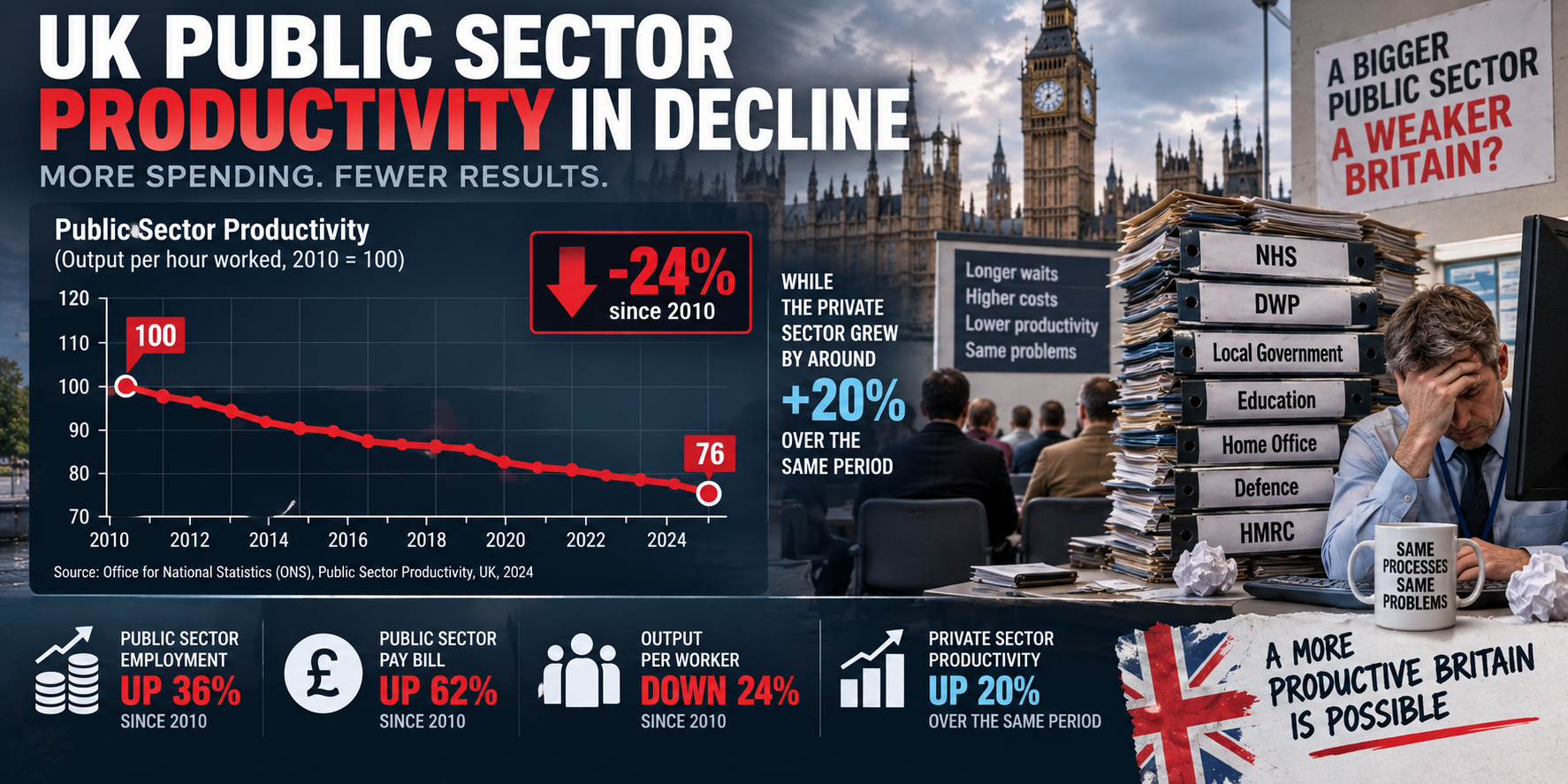
Declining public sector productivity has emerged as one of the UK’s most critical economic challenges, costing the economy an estimated £80 billion a year.
While the private sector has rebounded and outpaced its pre-pandemic performance, the public sector has experienced a severe productivity imbalance. ONS data shows that total public service productivity remains 2.5% to 3.4% lower than in 2019. The bloated state has become an immovable obstacle to Britain's progress.
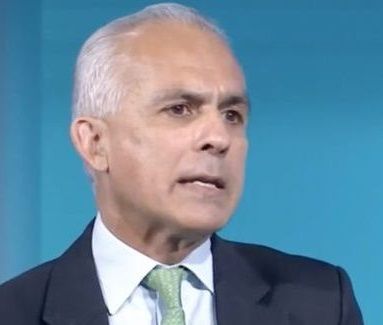
Reforming Britain’s Civil Service is not simply a question of cutting its size. For Danny Kruger MP, who is leading Reform UK’s preparation for government operation behind the scenes, it is more a question of radically engineering how it functions, driving greater efficiency and responsiveness to ministerial direction.
Reform UK believes Britain needs a fairly fundamental change in how government works: a smaller Civil Service, better rewards for high-performing officials, greater accountability for results and a reassessment of the influence of quangos and diversity, equity and inclusion policies across public institutions.
Speaking during a question-and-answer session at the Reform Conference 2026, Kruger set out some of the principles that he believes should underpin reform of the British state.
A Smaller but Better-Paid Civil Service
The Reform vision for Whitehall is for a “smaller and more strategic Civil Service,” while also expanding AI and digital capability.
One of the questions put to Danny Kruger at the Reform Conference concerned senior public-sector pay.
The questioner pointed to an approach he had encountered in the Netherlands, where senior officials in certain public bodies were subject to limits linked to ministerial pay, and the questioner asked whether Britain should consider something similar.
The view of Reform though, is that rather than focusing primarily on imposing a ceiling on salaries, Britain should be prepared to pay talented civil servants well — particularly if government wants to attract experienced people from business and other sectors.
“I'd like to see civil servants paid properly. I want high-quality people,” said Danny Kruger at the Reform Conference.
The crucial distinction, in the Reform argument, is between the salary paid to an individual civil servant and the total cost of the Civil Service.
The overall policy objective will be to reduce the overall wage bill by reducing the size of the organisation, while potentially paying some of the people who remain more competitively.
In other words, the model would be:
fewer civil servants, higher expectations and stronger rewards for performance. There will be more effective use of technology, with organisation re-engineering and a cultural change with a major training element.
There is a strong argument, accepted by Reform, that senior Civil Service salaries have already declined substantially in real terms and the next government needs to think carefully about whether existing salary structures are capable of attracting the skills Whitehall needs.
Bringing Private-Sector Expertise into Government
A central challenge for any government attempting major reform is attracting people with the necessary technical, commercial and managerial expertise.
Reform is arguing that Civil Service remuneration should make it easier to recruit experienced people from the private sector.
That becomes particularly important as government becomes increasingly dependent on expertise in areas such as artificial intelligence, technology, procurement, infrastructure and large-scale project management.
The question, therefore, should not simply be: how much are civil servants paid?
It should also be: what capabilities is the taxpayer receiving in return?
Reform's proposed direction is towards a Civil Service in which remuneration is more closely connected to responsibility, expertise and measurable performance.
Moving Towards Performance-Related Pay
At the Reform Conference, Danny Kruger was particularly critical of what he characterised as a traditional Civil Service employment model based on relatively predictable salaries, long careers and valuable pension arrangements.
He argued instead for greater performance-related remuneration.
His preferred system would pay talented officials competitively while holding them much more directly accountable for outcomes.
As he put it: “I want to be paying people well now and reward them properly, but hold them properly to account for outcomes as well.”
This represents an important distinction in Reform’s emerging approach to Whitehall reform.
The Reform objective would not necessarily be a low-pay Civil Service. It would be a smaller, more performance-oriented Civil Service.
That also raises some practical questions.
How should performance be measured in government departments? How can ministers distinguish between individual performance and failures caused by wider government policy? And how can performance incentives be introduced without undermining the political impartiality traditionally expected of permanent civil servants?
Those questions would have to be addressed in the design of any future reform programme.
The Core Problem for the Public Secor: Inputs versus Outputs
The decline in Civil Service productivity and wider public sector productivity is stark and it is being driven by a mismatch between the resources funnelled into the state and the services delivered. Between 2019 and late 2024, inputs into UK public services (staffing, infrastructure maintenance, and labour hours) swelled by nearly 25%. However, the actual output delivered to taxpayers only grew by 14%.
This has triggered warnings from institutions like the Bank of England, noting that hundreds of thousands of public workers have been added to payrolls without a corresponding rise in measurable output.
The productivity crisis varies significantly across different government services:
in healthcare, as the largest public sector component, the NHS is the biggest contributor to the slump. Healthcare productivity was 7.9% lower in 2024 than in 2019, weighed down by immense input pressures, rising backlogs, and staffing crises.
in the justice system, the courts system has witnessed the sharpest individual decline, dropping by roughly 12% since 2019, which has left criminal court backlogs exceeding 65,000 cases. Hundreds of court buildings are left idle without court hearings every day.
Elevated sickness absence rates and the prevalence of working-from-home arrangements across the public sector—contrasted with aggressive return-to-office mandates in the private sector—are frequently cited by analysts as barriers to efficiency gains.
Reforming the Quango State
The discussion at the Reform Conference also hinged around how to deal with Britain’s network of arm’s-length bodies and quangos.
Reform UK is arguing for reducing the number, the cost and influence of such organisations, sweeping them up so they come under minsterial portfolio. This is part of a broader attempt to restore clearer lines of democratic accountability.
The argument is straightforward: when important decisions are delegated to organisations operating at arm’s length from elected ministers, responsibility can become difficult for voters to identify.
If a policy fails, who is accountable?
Is it the minister? The department? The regulator? An independent agency? A statutory commission?
The Reform argument points towards a system in which ministers and elected governments will carry greater direct responsibility for policy, and greater tools to be able to deliver it.
Nothwithstanding that, abolishing or restructuring arm’s-length organisations also presents trade-offs. Such bodies can provide specialist expertise, regulatory continuity and a degree of independence from day-to-day political pressure.
The central debate is therefore not simply whether Britain should have quangos, but which functions genuinely require institutional independence and which should be returned to direct democratic control.
The DEI Question
To some people, the most contentious part of Reform's plans for the public sector are the bold plans for diversity, equity and inclusion policies, to remove these goals, together with all the distractions, the training requirements, the drag on resources and the division, that they bring to public bodies. Reform is essentially arguing that local councils, schools and government departments should not have responsibilities to deliver what are essentially political programmes such as critical race theory or other teachings designed to denigrate British values or British history.
At the Reform Conference Danny Kruger was asked how Reform UK would implement proposals to restrict DEI programmes across public institutions and whether political appointees could be used to enforce such policies.
The question is particularly relevant to DEI in schools and colleges.
We have to acknowledge there is a certain tension at the heart of this issue.
On one hand, Reform wants to challenge ideas and practices that it regards as ideological or politically partisan.
On the other, government itself could become more prescriptive overall if ministers were to somehow dictate precisely what teachers were permitted to say in classrooms.
Kruger explicitly recognised this problem: “We need free speech. We don't want government interfering precisely in exactly what is said in the classroom.”
The preferred long-term solution for Reform is therefore partly structural: making schools more accountable to parents and local communities, a movement for free speech that will naturally remove DEI, the tick-boxing and the prescrpitive way that community values are being taught.
Should Schools Be More Accountable to Parents?
Reform is arguing that greater parental and community accountability will naturally reduce the need for detailed central government intervention.
In our view, schools have become too heavily influenced by central government institutions, education bureaucracies and teaching unions.
Shifting accountability towards parents and communities will produce what most of us would regard as more balanced classroom practice, more freedom for pupils to think and learn, without the constant political pressure of DEI.
But Reform will probably still introduce clearer national rules in some areas.
These could include guidance concerning political advocacy in schools, critical race theory, teaching about biological sex and transgender issues, and the distinction between education and political campaigning.
The challenge will be defining those boundaries precisely.
A government seeking to prevent political indoctrination would simultaneously have to ensure that its own rules did not become a different form of political control over education.
That balance between political neutrality and academic freedom would therefore be one of the most important questions facing any such programme.
From Rules to Institutional Culture
There is a broader theme running through what Reform wants to achieve in this area.
Reforming government cannot be achieved simply by changing individual policies. It also requires changing the incentives and culture of institutions.
That applies to the Civil Service, public bodies and education.
For the Civil Service, Kruger envisages stronger performance incentives and greater accountability.
For quangos, the emphasis is on restoring clearer responsibility to elected politicians.
For schools, the emphasis is on strengthening accountability to parents and communities while defining boundaries around political advocacy.
Taken together, these proposals amount to an argument for shifting power away from permanent institutions and towards more directly accountable structures.
The Challenge of Reforming Whitehall
Civil Service reform has been attempted by governments of different political persuasions for decades.
The difficulty is that modern government is enormously complex.
Departments oversee huge budgets, sophisticated technology systems, international obligations, public procurement programmes and services affecting millions of people.
Reducing bureaucracy without losing institutional knowledge is therefore difficult.
Likewise, introducing private-sector expertise into Whitehall may improve commercial and technical capability, but government cannot operate exactly like a private company. Ministers and officials are constrained by Parliament, administrative law, public accountability and obligations that businesses do not face.
Any serious reform programme therefore has to distinguish between bureaucracy that genuinely obstructs government and institutional safeguards that exist for good reasons.
A Different Model for the British State
As Reform's politices are becoming clearer, all of this points towards a recognisable model of government that Reform UK is developing.
The Reform government will seek a smaller central bureaucracy, greater ministerial accountability, fewer arm’s-length institutions, stronger performance incentives and greater local and parental influence over public services.
Importantly, Reform's argument on Civil Service pay is much more nuanced than a straightforward programme of salary reductions or what trades unions might crudely call "cuts".
Reform is arguing that Britain could simultaneously reduce the total cost of Whitehall while paying some individual civil servants more.
That would mean reducing headcount, recruiting people with stronger specialist capabilities, rewarding high performance and expecting officials to accept greater accountability for results.
Whether such reforms could produce the improvements is going to depend heavily on implementation.
Reducing the size of government is relatively easy to announce. Redesigning institutions so that a smaller state actually works better is considerably harder. It is the really important and most difficult aspect of government that has not been approached in any sense by either Labour or the Conservatives.
The devil, of course, is going to be in the detail. But Reform is up to the task.
It is ultimately the challenge facing Reform UK — and any government serious about reforming Whitehall.
The question is not simply how to make the British state smaller.
It is how to make it more capable, more accountable and more responsive to the people it exists to serve.




Real Change for Britain and Protecting Free Speech Will Take Courage to Vote For Something Different