
Powering Britain: Reform's Plans for Energy Cost Cutting Explained
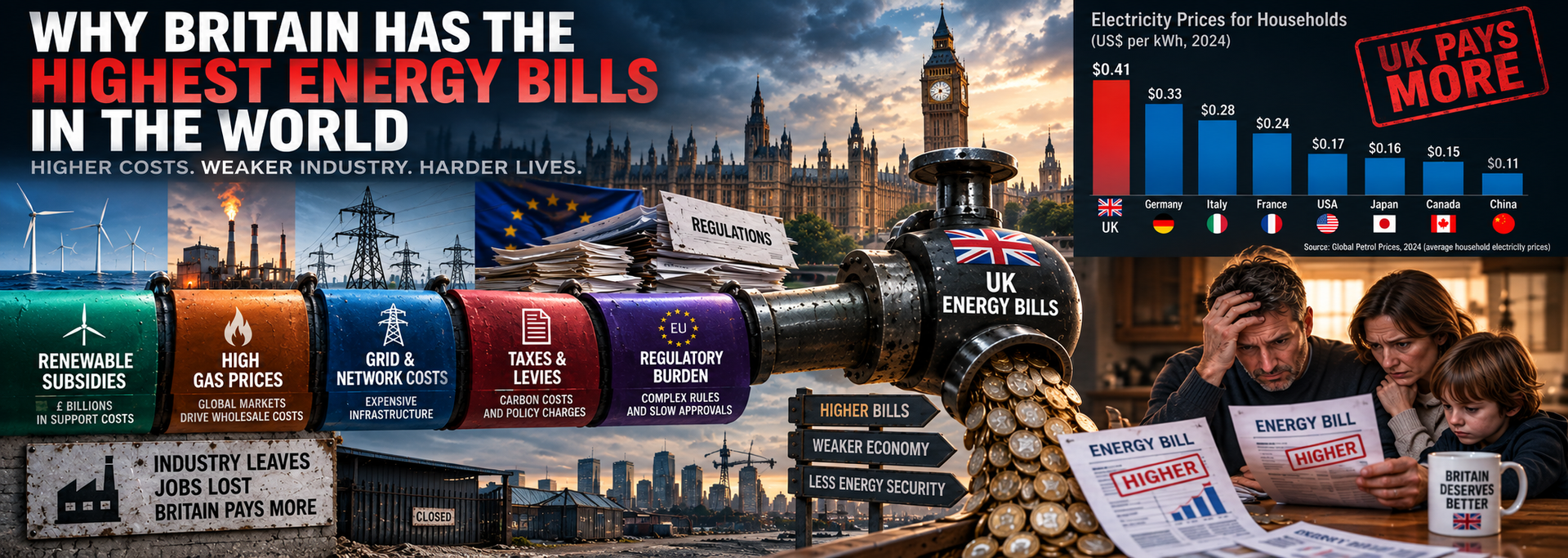
Britain's energy supply currently has the worst of all possible worlds: record high costs, exposure to global conflict and global prices, and a massive burden of green mandates, levies, transfer pricing, and Carbon Price Support (CPS) on gas generators.
Britain cannot become a prosperous industrial economy again without abundant, reliable and affordable energy.
That is the starting point for Reform's argument for cutting he UK's existing Net Zero policy framework. Reform wants to join nations like the USA, Australia, Netherlands and others, who are scrapping the long-term 2050 Net Zero targets, to cut costs and to reprioritise domestic jobs and domestic energy production.
Speaking during a Reform Conference 2023 discussion about electricity prices and energy policy, Richard Tice MP set out the case for the Reform approach: reducing renewable subsidies, cutting carbon-related charges, reconsidering expensive grid expansion, restoring domestic oil and gas production and rebuilding dependable electricity generation.
In the Reform argument, the objective of Government should be straightforward: to bring down our record-breaking high electricity prices, restore British industrial competitiveness and strengthen the country's energy security. For Reform UK, this represents considerably more than changing an environmental target. It means restructuring Britain's entire energy strategy.
Britain’s Energy Problem Is an Economic Problem
Energy policy is often discussed primarily in environmental terms. At Reform we say this should be reframed and understood as economic policy.
Every factory needs energy. Every data centre needs electricity. Every shop, office, warehouse and transport network depends upon reliable power.
Households experience energy policy directly through their bills.
Consequently, when electricity becomes structurally expensive, the effects spread throughout the economy.
Manufacturers become less competitive. Investment becomes less attractive. Businesses pass the costs onto consumers.
Then as a resullt household disposable incomes fall.
And energy-intensive industries face increasingly difficult decisions about whether production remains commercially viable in Britain. It becomes a doom spiral of rising energy costs and smaller industrial capacity.
For Reform, reducing energy costs should therefore be regarded as a central component of any future growth strategy. Many countries have begun a pragmatic retreat from the Net Zero timelines, even if they have not abandoned Net Zero altogether, as the US has done.
Faced with infrastructure bottlenecks (like grid congestion) and public anger over high energy prices, governments around the world are choosing to slow down implementation, effectively pushing the heaviest decarbonisation burdens past 2030 and beyond.
Here in Britain, the compounding crisis of uncompetitive industrial electricity prices (among the highest in the developed world), coupled with geopolitical shocks from the Iran conflict disrupting global gas markets, has forced numerous energy-intensive industries UK to shut down, scale back, or relocate.
The sectors hit hardest by closures and financial collapse include Britain's oil refineries and petrochemicals. Thousands of jobs are being lost due to Net Zero.
The Grangemouth Refinery, one of Scotland’s most critical pieces of industrial infrastructure shuttered its oil refining capabilities. The Lindsey Oil Refinery followed shortly after, leaving Britain with only four operational refineries and heavily expanding our import dependency for diesel and aviation jet fuel.
On Teesside the American-owned chemical giant Huntsman has warned of imminent shutdowns at remaining British facilities due to soaring spot energy prices, noting it is cheaper to import products from China or the US. At Scunthorpe British Steel has been plagued by massive daily operating deficits and the site required direct government intervention. Cross-party MP committees have flagged that Britain lacks a viable profitability plan for sovereign steelmaking.
British fertilisers and other industries such as paper, glass and ceramic making have also seen plant closures. Output in these heavy sectors has steadily shrunk, with many operations scaling back factories or choosing to import bulk products from overseas rather than manufacturing them domestically.
Rather than deal with the root cause, the Labour Government's response has been to launch the British Industrial Competitiveness Scheme (BICS) and the British Industry Supercharger. These offer discounts on electricity network charges to thousands of eligible manufacturing firms. However, industrial bodies point out that these measures are no more than short-term sticking plasters rather than structural fixes to the country's grid issues.
Britain’s Industrial Electricity Prices
The international cpst comparison is particularly concerning for British industry.
Britain's industrial electricity prices have been extremely high compared with those faced by businesses in many competing economies.
There are several reasons for this.
Wholesale gas prices (and the associated levies and green taxes) matter. Network costs matter. Taxation matters. Environmental levies and renewable-support schemes matter.
Balancing an increasingly complicated electricity system also carries costs.
The debate is therefore not simply about the price at which a wind farm or gas plant generates an individual unit of electricity.
The economically important figure is the total cost of delivering reliable electricity to the consumer.
That distinction sits at the heart of our Reform argument.
The Hidden Cost of the Electricity System
Renewable electricity is frequently discussed in terms of the generation cost of wind or solar power. At the Reform Conference, in his speech, Richard Tice demonstrated that this does not capture the full cost of the system.
Wind and solar generation vary with weather conditions. Electricity supply and demand, however, must remain balanced continuously.
That means an electricity system with large amounts of intermittent generation also requires networks, balancing mechanisms, storage, interconnection or dispatchable generation capable of responding when required.
There are then additional costs associated with expanding the transmission network to connect new generating capacity.
Our Reform argument is therefore that energy policy should be evaluated on a whole-system basis. The recent blackouts in Spain showed the risks of relying on an energy system which is inherently intermittent and reliant on the behaviour of the weather.
The relevant question is not simply: how cheaply can this wind farm generate electricity?
It is: how much does the complete electricity system cost while maintaining reliable supply?
This is not a complex question to grasp. When intermittent sources of energy (wind, solar) have to be backed up with a fail-safe of continuous supply from other sectors (gas,nuclear, coal), the cost of green energy is always going to be higher than the cost of the back up alone.
Reform Will Reverse the Direction of Travel
Our Reform proposals are more radical than simply slowing Britain's Net Zero timetable. A future Reform government will actively unwind substantial parts of the existing policy architecture.
That will involve changes to legislation. Some taxes and levies will be abolished.Subsidies could be removed. Existing support schemes could be reviewed. Future contracts could be cancelled. Some existing agreements could potentially be renegotiated.
Government spending programmes associated with decarbonisation could be reduced or eliminated.
In other words, Reform's proposal is not simply: stop adding new Net Zero policies.
It is: to start dismantling parts of the system already created, and make it start working in the interests of the consumer again.
A £30 Billion Cost-Reduction Ambition
The Reform plan is to remove approximately £30 billion annually from projected electricity-system costs by around the end of the decade.
On an electricity system delivering roughly 300 terawatt-hours annually, the argument presented is that £30 billion represents approximately 10 pence per kilowatt-hour.
Whether the full cost reduction could actually be achieved would depend on wholesale prices, contracts, network investment, government finances and how the reforms were implemented.
Nevertheless, the scale of the ambition is becoming clearer as we get closer to the next election.
Reform is not contemplating marginal reductions in energy costs.
We are discussing a fundamental restructuring designed to make British electricity substantially cheaper.
Reforming the Renewables Obligation
One target is the Renewables Obligation. Introduced to encourage investment in renewable electricity, the scheme requires suppliers to support qualifying renewable generation.
It has been closed to most new generation since 2017, but consumers continue to support existing projects.
Richard Tice MP and others have been urging that the remaining costs should be reduced much more rapidly.
The wider principle is that subsidies introduced to establish technologies should not necessarily continue indefinitely once industries have matured.
Supporters of the existing arrangements would counter that investors committed capital on the basis of long-term policy frameworks and that retrospective intervention could increase perceptions of political risk.
That creates an important trade-off.
Reducing legacy costs at the end of the day is going to lower energy bills.
But governments also need to consider the effect that changing established arrangements could have on confidence in future UK infrastructure investment.
Contracts for Difference Would Face Major Reform
The Contracts for Difference system would also be targeted.
CfDs provide qualifying low-carbon generators with a contractual strike price for their electricity.
When the relevant market price is below the strike price, support is paid to the generator so that they are effectively guaranteed a supply price, underwritten by bill payers and by British taxpayers.
When it is above the strike price, generators can pay money back.
Richard Tice MP argues that a Reform government should cancel certain future CfD commitments and examine whether some existing contracts could be renegotiated.
A Reform government will contemplate legislation if voluntary renegotiation proves impossible.
That would represent a major intervention in established contractual arrangements and might raise some legal and investment questions.
The Reform argument is that government cannot regard contracts as politically untouchable if their cumulative effect imposes excessive costs on households and businesses.
The counterargument is that governments need to consider carefully what retrospective intervention would do to the cost of financing future British infrastructure.
Carbon Pricing Would Be Targeted
Carbon pricing is another major component of the proposed reforms.
Britain currently uses the UK Emissions Trading Scheme to place a price on emissions from covered sectors.
Reform argues that carbon costs ultimately feed into electricity prices, particularly where gas-fired generation is setting the marginal wholesale price.
Reform therefore wants to reduce or abolish significant carbon-related charges.
This illustrates the fundamental difference between the two approaches to energy policy.
Supporters of carbon pricing regard it as a mechanism for incorporating the environmental cost of emissions into economic decisions and encouraging investment in lower-carbon alternatives.
Reform regards the resulting increase in energy costs as damaging to competitiveness and living standards.
The disagreement is therefore not merely about implementation.
It concerns what energy policy should prioritise. At its heart, the Reform policy makes the case that Britain has already made substantial strides in carbon reduction. The British consumer should no longer have to carry on carrying the huge costs of what has become an ideologically-driven energy sector, created by Conservative and Labour governments of the past.
The Grid Expansion Question
Another substantial cost in the current energy mix is Britain's electricity network.
Moving large quantities of electricity from geographically dispersed wind and solar installations requires considerable transmission infrastructure.
National Grid and other network operators are investing heavily in upgrading the system. But this expansion is itself partly a consequence of the chosen generation strategy.
A different generation mix could therefore require a different network.
Reform would consequently review planned grid investment rather than accepting every proposed expansion as inevitable.
This is an important point because energy infrastructure has very long investment horizons.
Decisions taken today can affect consumer bills for decades.
But reducing investment also involves risks.
Britain needs sufficient network capacity regardless of the generation mix, particularly as electricity demand potentially increases through data centres, industry and new technologies.
The challenge is determining which investment is essential and which exists primarily to support a particular Net Zero pathway.
The Intermittency Problem
With the Reform vision for Britain's future energy mix, we also have to look closely at intermittency, as touched on previously.
Wind and solar can produce large quantities of electricity when conditions are favourable. But output varies.
When renewable generation falls while demand remains high, another source of electricity must compensate.
That can involve gas generation, storage, interconnection or other dispatchable capacity.
Conversely, when renewable generation is abundant but the network cannot use or transport all of it, generators can sometimes be paid to reduce output.
These balancing and constraint costs form part of the wider electricity-system debate.
Ar Reform we make the case that Britain has concentrated too heavily on building intermittent generating capacity without sufficiently accounting for the cost of making the overall system dependable. Again, the total cost of intermittent energy sources plus back up sources, will always cost more than the cost of the back up alone.
Britain Needs Reliable Power
This leads to another central principle of our Reform plan: Britain needs more firm power.
Firm power means electricity generation that can be made available reliably when required rather than depending principally on weather conditions.
That could include gas generation and nuclear power, alongside other technologies capable of providing dependable capacity.
Britain should rebuild this part of its electricity system. This does not necessarily require eliminating every wind turbine or solar installation.
It means constructing an energy system in which security of supply is not dependent upon favourable weather.
For Reform, reliability should be designed into the system rather than treated as a secondary problem to be solved after renewable capacity has been installed.
British consumers for too long have suffered the consequences of governments not building enough resilience into the energy mix, to the extent that Britain was forced to import over 14 % of our electricity use in 2024, despite being surrounded by rich sources of our own oil and gas, both onshore and offshore. Overall in 2024 Britain had to import 43% of its energy, mostly foreign oil and gas.
It is an industrial policy based on high costs and foreign dependency that is doomed to fail.
Restarting Britain’s Oil and Gas Industry
The Reform strategy will also include renewed development of Britain's domestic oil and gas resources.
Reform argues that continuing to use fossil fuels, for example from Norway, Qatar or US shale gas, while deliberately restricting domestic production will simply increase dependence upon imports. The recent data shows this to be correct.
From an energy-security perspective, we want Britain to produce more of the energy it continues to consume.
The argument is that domestic production can support employment, tax revenues and security of supply while reducing reliance on foreign producers.
Opponents argue that expanding oil and gas production risks locking in fossil-fuel infrastructure and making legally binding climate objectives harder to achieve.
There is also an important economic limitation: oil and gas operate in international markets, so increasing domestic production does not automatically insulate British consumers from global prices. But when oil and gas or nuclear producers are signed up to fixed price domestic supply agreements, most certainly those reduced costs will start to flow.
The energy-security argument is therefore stronger than a claim that domestic production alone guarantees cheap energy.
Carbon Capture and Hydrogen Would Face Scrutiny
So naturally at Reform we are sceptical about technologies being promoted as part of the Net Zero transition. Governments have been very opaque in the way they have loaded substantial taxes and contract costs onto oil and gas consumers, so as to continue the Net Zero narrative.
Carbon capture and storage would face substantial reductions in government support under the approach being outlined by Reform.
Green hydrogen programmes would also be reconsidered. Our objection at Reform is based on efficiency and cost.
Converting energy into hydrogen and subsequently using that hydrogen involves energy losses.
Capturing, transporting and permanently storing carbon dioxide also requires additional infrastructure and energy.
Supporters argue that these technologies may nevertheless be important in sectors that are difficult to decarbonise directly, including parts of heavy industry.
A Reform government would apply a much tougher economic test: does the technology really produce enough economic and strategic value to justify taxpayer support?
Heat Pumps and Home-Decarbonisation Subsidies
Household energy policy will also change under the Reform government.
The Reform strategy proposes ending or reducing programmes that subsidise heat pumps and other home-decarbonisation measures based on, at best, flimsy and unproven scientific principles.
The argument is that government should not use taxation or energy bills to push households towards particular technologies.
The alternative view is that upfront subsidies can accelerate adoption, build supply chains and eventually reduce costs.
The Climate Change Committee responsible for setting Britain's carbon budgets, for example, argues that electrification can reduce household energy costs under the right conditions, although it also acknowledges that Britain's unusually high electricity-to-gas price ratio remains a significant problem.
Interestingly, this creates an area of partial agreement between otherwise opposing positions.
Both Reform's critics of Net Zero and the Climate Change Committee increasingly recognise that British electricity needs to become cheaper.
They disagree profoundly of course about how that should be achieved.
Moving Social Costs Away From Energy Bills
Not every energy proposal coming Reform is going to involve eliminating programmes.
Some involve changing how they are funded.
The Warm Home Discount, for example, provides support for eligible lower-income households but is financed through the energy system.
Richard Tice MP in his presentation suggested that this kind of social support should instead be financed through general taxation and the benefits system.
There is a straightforward economic argument behind this.
If government wants to redistribute income, it can do so transparently through taxation and spending rather than increasing the price of electricity.
The Climate Change Committee has similarly argued for removing policy costs from electricity bills, although as part of an ideology intended to encourage electrification rather than dismantle Net Zero, and without any consumer benefit.
Again, different political philosophies can sometimes identify the same structural problem while proposing very different long-term solutions.
What is clear though,is that there is no public interest in hiding energy costs covertly within the already-ballooning benefits system.
What Happens to the Climate Change Committee?
Richard Tice MP also proposes institutional change.
The Climate Change Committee would be abolished under the Reform energy strategy. Other energy institutions and government structures would be substantially reorganised.
The rationale is consistent with Reform's wider programme concerning quangos and arm's-length bodies.
If government changes its fundamental energy objectives, institutions established to advance the previous framework would inevitably face review.
Supporters of the Climate Change Committee argue that independent expert scrutiny helps governments understand the long-term consequences of energy and climate decisions.
Reform's position raises the opposite democratic question: if elected governments decide to pursue a fundamentally different energy strategy, how much influence should unelected statutory bodies exercise over that choice?
One thing that nobody can deny: the Climate Change Commitee has presided over massive increased costs of energy being loaded on Britain's industrial and household consumers.
How Can the Plan Be Revenue Neutral?
Reducing levies and carbon-related revenues will create new challenges for the Treasury.
Subsidies and taxes removed from electricity bills do not automatically disappear from the public finances.
The Reform plan therefore attempts to identify offsetting savings, to make the changes fiscally neutral to the public purse.
Richard Tice MP points towards reductions in spending on carbon capture and storage, heat-decarbonisation programmes, green hydrogen, international climate finance, EV incentives and other Net Zero programmes.
The argument is that the overall package could be designed to be broadly revenue neutral for the Treasury while producing substantially lower electricity-system costs.
That claim would require detailed independent costing once a complete policy package exists.
But the objective is important.
Reform wants to argue that cheaper electricity need not simply mean transferring tens of billions of pounds of costs from consumers to taxpayers.
It wants to remove the underlying expenditure as well.
The Investment-Risk Question
There is, however, one major issue any government pursuing such a programme would have to confront. Britain needs enormous amounts of private investment in energy.
Nuclear power stations, gas plants, electricity networks and other infrastructure all require capital. Investors care about expected returns. But they also care about whether governments honour established rules and contracts.
A policy of retrospectively changing support arrangements could therefore lower some existing costs while potentially increasing the risk premium demanded by investors financing future projects.
That does not mean contracts or policies can never change. Governments change regulatory frameworks constantly.
But a serious programme will need to demonstrate how Britain could achieve both lower energy costs and a credible long-term investment environment. It is going to involve accelerating Britain's much-delayed Small Nuclear Reactor (SMR) programme, accelerating the issue of new oil and gas licences, and creating the pricing and investment landscape for this to happen.
The new types of clean coal technology could also be a part of the mix. Britain, for now, continues to consume coal for steel making and other heavy industries.
Energy Security Means Diversity
The wider energy-security question should also extend beyond the argument between fossil fuels and renewables. A resilient energy system should avoid excessive dependence on any single technology, fuel or foreign supplier.
Domestic oil and gas can contribute to that resilience. So can nuclear.
Renewables can reduce fuel-import requirements because wind and sunlight do not have to be purchased from international commodity markets.
Storage and interconnectors can provide flexibility.
The strategic question for the next Government is therefore how those technologies should be combined, and at what total cost.
Reform's distinctive argument is that affordability and dependable generation have been given insufficient weight within that calculation over many years.
From Net Zero to an Energy-Abundance Strategy
Perhaps the clearest way to understand the Reform argument is that we want Britain to replace a decarbonisation-first strategy with an energy-abundance strategy.
The first question would no longer be: how rapidly can Britain reduce the carbon intensity of the energy system?
It would become: how can Britain produce abundant, reliable electricity at internationally competitive prices?
Environmental consequences would still exist and would still require policy responses.
But they would no longer determine the architecture of the entire energy system. For Reform UK, that represents the fundamental change.
Cheap Energy as Industrial Policy
The implications for this strategy extend far beyond household bills. Artificial intelligence requires enormous amounts of electricity to be consumed in data processing centres. Advanced manufacturing requires reliable power. As mentioned previously, steel, chemicals and other energy-intensive industries depend heavily on energy prices. This is going to continue for many years into the future.
Future investment decisions will increasingly compare jurisdictions partly according to the availability and cost of electricity.
Cheap energy can therefore function as industrial policy.
Instead of government attempting to identify every future industry and subsidise individual companies, it can create an economic environment in which a wide range of businesses find it profitable to invest.
The clear Reform argument is that abundant energy provides an economy-wide competitive advantage.
If Britain can substantially reduce electricity prices, the benefits could spread far beyond the energy sector itself.
The Choice Facing the Next Government
Britain's energy debate is consequently becoming much larger than the question of whether Net Zero can, or should be achieved in 2050. It is becoming a debate about Britain's economic model.
How much should consumers pay to support decarbonisation? How much renewable capacity should the country build? How should intermittent generation be backed up? How much should Britain invest in electricity networks? What role should nuclear power play? Should domestic oil and gas production expand? Which costs belong on electricity bills and which belong in general taxation?
And how much economic cost should governments accept in pursuit of emissions targets?
Reform UK is providing one increasingly clear answer.
Britain must reverse substantial parts of the existing Net Zero framework, reduce subsidies and carbon costs, expand dependable domestic energy production and make lower electricity prices a central economic objective.
Critics argue that such an approach could undermine emissions reductions, weaken some areas of investment confidence and sacrifice the (ideological) benefits of moving away from volatile fossil-fuel markets.
That is the choice the emerging energy debate will have to confront.
Britain Needs an Energy Policy That Works
Whatever happens to Net Zero, one principle is difficult to dispute.
Britain needs an energy system capable of supporting a modern industrial economy.
It must keep the lights on.
It must remain resilient during international crises.
It must provide power for new industries and technologies.
And its costs cannot become so high that British businesses are placed at a permanent disadvantage against international competitors.
For Reform, that requires dismantling much of the policy architecture constructed around Net Zero and replacing it with a strategy centred on affordability, reliability and national energy security.
The scale of the proposed reforms would make this one of the most consequential changes undertaken by any future Reform government. Because energy policy ultimately reaches into almost everything else.
Cheap and reliable power means lower costs for households.
It means a more competitive environment for industry.
It means greater resilience during geopolitical shocks.
And in Reform UK's argument, it provides one of the foundations on which Britain could begin growing again.
The fundamental question is therefore becoming: should Britain's energy system continue to be designed primarily around achieving the notion of Net Zero? Or should affordability and energy security once again become its overriding priorities?